
Pet behaviour school
Leading on from our Basic Training features, we're graduating to the Pet Behaviour School with Battersea's Behaviour team.
- Lesson One: Fireworks
- Lesson Two - Christmas
- Lesson Three - New pet in the family
- Lesson Four - Summer
- Lesson Five - Indoor Cats
- Lesson Six - Naughty Boy...
- Lesson Seven - Say it, don't spray it!
- Lesson Eight - Don't leave me this way
- Lesson Nine - Children and dogs
- Lesson Ten - Leading to frustration
- Lesson Eleven - Aggression in cats
- Lesson Twelve - Chewing
Lesson One: Fireworks
 Battersea Dogs & Cats Home often receives reports of distressed and lost pets during the autumn months due to fireworks. In our first lesson in the pet behaviour school, Ali Taylor, Battersea's Head of Behaviour, addresses the most common problems and preventative measures pet owners can take during the
firework season.
As you get to know your dog or cat, you will notice changes in his or her behaviour in various situations. During the firework season, which can stretch from the end of October right into January, many pets suffer from adverse reactions to the unusual and sudden sights and sounds associated with fireworks.
- Commonly seen signs may include:
(Of course, if any of these symptoms become excessive or persist after the fireworks have stopped, you should seek veterinary advice as they may be related to a medical condition)
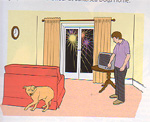 Unfortunately, it can be difficult to treat a fear if the event that causes it is infrequent or unpredictable. This is also the case with thunder. Dogs and cats have very good hearing and can be very sensitive to loud noises, even from afar. In panic or confusion, they can go to great lengths to escape such as digging under fences, jumping out of open windows or doors, and chewing through leads.
 - What can I do to help my nervous pet?
Whatever you decide to do - remember that your pet has no idea what fireworks are and may or may not react to them. Be gentle and try to avoid unnecessary stressful situations where possible.
- What if my pet goes missing?
Contact your local dog warden or police station to record your pet's details, and call all the local rescue centres to see if your pet has been found and taken into their care. Advertise the loss of your pet by putting up posters in your area, local shops and veterinary surgeries.
If you live within the M25, contact the Lost Dogs and Cats Line at Battersea Dogs & Cats Home immediately, on 0905 477 8477. Calls are charged at 60p per minute.
Lesson Two - Christmas
 Christmas is a time for celebration, family gatherings, food, presents and lots of excitement. In some households Christmas can be quite chaotic - what with organising family reunions, the Christmas dinner, the tree, the presents, and the decorations whilst trying to keep the children happy and the in-laws as far apart as possible. However, in some households the pets are often forgotten about amongst all this mayhem which can lead to behavioural problems. Lesson Two helps you make Christmas the season of goodwill for everyone in your household, including your pets. Ali Taylor addresses the various problems that your pet may experience during the Christmas period.
The festive season is also a very exciting time for our pets what with all the food, people and presents around, however it can also prove to be traumatic. Like human beings, some animals will be highly excitable, others may be timid and shy and some may simply want to join in the Christmas fun. Whichever category your pet falls into, all dogs and cats should be supervised throughout the festivities in order to prevent any casualties.
- Common problems to be aware of over Christmas
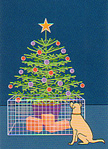
- Don't let these issues worry you too much, as it's easy to avoid most pet related Christmas disasters. As most problems arise from the Christmas tree itself, here are three easy steps to follow to ensure a pleasant, painless Christmas:
For additional peace of mind, find out when your veterinary surgery is open over the holiday season, or the number of another vet that has an emergency service available. But most of all - don't forget about your furry friend over the festive season. If you know that your dog or cat may behave in a particular way - think about ways to avoid incidences and accidents. He can enjoy Christmas as much as you!
Lesson Three - New pet in the family
 Are you thinking about taking on a pet? Afraid of making the wrong choice? In Lesson Three, Ali Taylor our Head of Behaviour, explains what to think about before taking the plunge.
When thinking of buying or rehoming a new pet it is very important to do your research before hand and consider all the aspects of pet ownership. All dogs and cats require special attention and each have varying needs. Some will require more exercise, time and training then others, not to mention grooming, feeding and veterinary treatment. All dogs and cats differ in personality but people often buy an animal based on its cute looks and often forget about temperament. Owning a pet is a life long commitment and your new pet may be with you for the next 15 years or more, so you must be confident that you are completely able commit yourself for this length of time.
- Questions to ask yourself

- Rescue pets
- what to think about before getting a rescue pet
In our opinion, rescue dogs and cats are even better than those bought from other sources. However, they will need as much if not more attention to ensure that they settle into their new home comfortably. When considering a rescue pet you should be aware of the following:
Most importantly - if you are at all worried about your new pet's behaviour seek help straight away. Don't allow an issue to develop and become a behavioural problem - call Battersea Dogs & Cats Home's Behaviour Advice Line on 0905 020 0222 (calls cost 25p per minute).
Lesson Four - Summer
 It is true to say that with good weather there is an increase of people in our local parks - more dog walkers, sunbathers, picnickers and children, due to the school holidays. In Lesson Four, Ali advises pet owners on things to remember during the summer.
Because there are so many more people out and about in the summer, it's even more important to ensure you are in control of your dog in public places as he is more likely to meet a tempting situation, and not everyone will understand. Keep him on a lead in public places and practice recall with your dog.
- Summer heat dangers
If your dog does get heat stroke, you need to cool his body temperature down using cold water or ice packs will do. But, don't the dog too much and lower the body temperature too far - a ten-minute application of towels soaked in cold water should be sufficient. It is advisable to then take your dog to a vet for a check up even if he appears fully recovered.
- Behaviour issues
The most common problems we deal with at this time of the year on the Behaviour Hotline, or see in dogs coming in for adoption, is destructiveness, messing or barking. Most owners we speak to are confused and feel that their pet has become disruptive for no valid reason as most of these pets have never displayed this type of behaviour previously.
What we do know is that more people are likely to take a well earned break from work around this time, and school children are on holiday, so pet owners spend more 'quality time' with their pets. Without even realising it, your pets normal routine will have been altered and he has to adjust to the change. Perhaps you have increased his exercise because you have the time to spend with him and, like any athlete, an increase in exercise means he will have even more energy to burn.
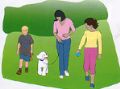 With you and the children around even more, your dog will soon become accustomed to having his 'pack members' around. What he won't understand is that this is short term and he will soon have to become more independent again - this is the time when problems start to develop. When you've returned to work or the children have gone back to school, your dog may start to feel insecure about being left on his own. He may become bored or have devised a tactic such as barking, as he thinks this is what gets you to return even if it is four hours or so later. Spending quality time with your dog is important in order to strengthen the relationship but if this is done infrequently then it will only complicate matters.
 - Summer rules
Lesson Five - Indoor Cats
 The Behaviour Advcie Line at Battersea Dogs & Cats Home receives many calls from cat owners experiencing problems with their moggies getting up to mischief - in most cases it's simply because they are bored. In Lesson Five, Nancy Clarke, one of Battersea's Advice Line behaviourists, explains how and why to keep your cat both mentally and physically stimulated indoors.
- Why would my cat not be happy?
Some problems that can arise when your cat cannot satisfy her natural instincts include boredom, frustration, hyperactivity, aggression to people or other cats and fearfulness. Cats that are restricted indoors are more likely to develop behaviour problems than cats that have access to outdoors. Many indoor cats that sleep during the day cannot be expected to sleep throughout the night as well. Remember that a cat is a nocturnal animal and if we do not provide an alternative playtime then the cat will make up its own routine. Therefore cat stimulation is important for any cat but especially for indoor cats.
- Food for thought / food for the brain
- cat and mouse!
- you scratch my back and I'll scratch yours!
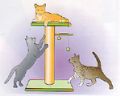 A scratching post is a must, as outdoor cats will naturally sharpen their claws on trees or fences, your indoor cat may take to doing the same thing to your furniture! Tall scratching posts can keep your cat active as she can climb from shelf to shelf, or you could attach old pieces of carpet to a wall, which your cat can scratch. You can encourage the cat to use the scratching posts by dusting them with catnip.
 - High and mighty!
- Catnip and cat grasses.
Lesson Six - Naughty Boy...
 The Behaviour Advice Line at Battersea Dogs & Cats Home receives many calls from owners who are not happy with their dog's behaviour and as a result are tempted to punish the dog for unwanted behaviours, which often doesn't work. Kathryn Thorpe and Nancy Clarke, our advice line behaviourists, explain the do's and don'ts of punishing your dog for unwanted behaviours.
- Why doesn't punishment work?
Even worse is the fact that where the behaviour is caused by anxiety or fear, the use of punishment can intensify the occurrence and severity of the behaviour problem. For example, a dog that becomes nervous or insecure when left alone in the home may mess in the house. When the owner returns they may verbally or physically punish the dog and therefore further heighten the dogs general anxiety levels. It then follows that the dog is even more likely to mess in the house when left alone.
- Getting the timing right
- Punishment means receiving attention
Alternatively the owner may have used punishment in a repetitive and untimely manner, meaning the dog no longer reacts to it. For instance, the punishment may start with the owner shouting 'come' every time their dog runs off on a walk. To begin with the dog pays attention to his owner when he shouts, but learns over time that when it returns to the owner it doesn't get a nice welcome. Subsequently, when the dog runs off the owner starts to get really angry, shouting even louder and more frequently. The dog, unwilling to return to its owner, soon becomes confused about the 'come' command, and, because his owner shouts every time he runs away, quickly believes the command 'come' means 'don't come back'.
- Breakdown in human-dog relationships
- Is punishment ever appropriate?
 In order to show disapproval of a dog's behaviour, the owner has to act at the same time as the behaviour is actually occurring. The owner can try startling the dog by making a sudden loud noise (e.g. banging a book on a table). Great care must be taken however as the owner does not want the dog to associated the loud noise with the owner but with their own behaviour. Therefore the owner must not look or interact with the dog during the process. The dog must think to itself, "although my owner doesn't seem to notice me, that horrid loud noise happens whenever I do this - I don't like that noise so I will try to avoid it by not doing this again".
Lesson Seven - Say it, don't spray it!
> It is quite normal for cats to make their presence known in their own territory, often by scent marking, which includes spraying. Kathryn Thorpe, Battersea's Behaviour Advice Line behaviourist, takes a look at this problem and gives some helpful hints on how to stop it happening.
- What is scent marking?
- Why do cats spray?
An insecure cat may start to spray urine around the house. Spraying indoors is a normal response for the cat in such circumstances, but undesirable from the owner's point of view in the home.
The typical reasons a cat will become insecure and start spraying indoors include:
Outside noises or disruptions such as building work or changes to the cat's resting-place
Redecorating or even bringing new furniture into your home
The threat of other cats that they are living with or that are entering their territory
The arrival of a new cat, dog or person in the family or the temporary loss of a family member
Indoor spraying seems to be more common in homes that have more than one cat and tends to occur where there is some kind of conflict or problem, such as around doors (if there is another cat lurking on the other side) or curtains where the cat can see rival cats outdoors. New items brought into the house may get sprayed, or even owner's clothes. Some cats also develop odd spraying habits such as against washing machines or visitors. However, insecure cats tend not to spray around their bed area or den, as they prefer to mark these areas with facial rubbings.
- How can spraying be treated?
Avoid punishment: even if a cat is caught in the act of spraying, verbally or physically punishing the cat will only increase its anxiety levels and may make the problem worse.
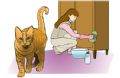
Clever cleaning: not cleaning the area properly can further fuel the problem. Use one part biological washing powder to nine parts water to clean the area, wait for this to dry and wipe over with surgical spirit. Deny your cat access to the area while it is drying. Don't use anything containing ammonia or chlorine, like bleach or detergents, as this will emphasise the urine smell to the cat who may then spray urine in the same place again. Placing food or a bed near the cleaned area can help as the cat will be reluctant to spray there again.
Make a diagnosis: spraying may occur for just one or a combination of different reasons. If you can identify where and when the behaviour started and what else may have changed in the environment that may have triggered your cat to start spraying, you can attempt to remove the reason for the cat's anxiety. For example, if another cat is threatening your cat's territory by coming in through the cat flap, block up the cat flap for a time so it can't come in.
Ask a behaviourist: spraying can be triggered by a number of reasons and sometimes the cat may have been doing it all its life. If you think the problem may be complex, seek the advice of a feline behaviourist or contact Battersea's Behaviour Advice Line for advice on 0905 020 0222 (calls cost 25p per minute).
Lesson Eight - Don't leave me this way
 Of all the calls the Behaviour Advice Line at Battersea Dogs & Cats Home receive every day, some behaviour queries and concerns are more common than others. In this lesson we ask our behaviour advisors to answer the common question - why does my dog bark when I leave him?
Being left alone can be very hard for some dogs to come to terms with. If your dog barks as soon as he is left then he's suffering from anxiety and has become over attached to you - barking helps him cope with the stress. It is very important to get a dog like this used to being left alone and there are a number of ways to do it.
- If there's a room in your home where your dog feels happy and relaxed, you could start leaving your dog in this room. Build up the time slowly so that your dog begins to get used to the idea of being left.
- Try closing the curtains, playing music or leaving the television on. Place something that smells of you outside of the door, along the bottom, to persuade the dog that you are in and around the house. You should also make sure that your dog is well exercised before you go out.
- When you leave a room, place a stuffed Kong or marrowbone on the floor for your dog. On returning, draw attention to the Kong, pick it up and put it away. You can then use this technique when you go out so the dog associates your leaving him with a positive, tasty experience.
- Help alleviate your dogs anxiety about you leaving the house by getting him so used to your leaving routine that he no longer takes any notice. Get ready to go out as normal, but instead of leaving the house go and read a book or watch TV for a few minutes, ignoring your dog's reactions. Carry out this routine as often as you can and at different times of the day. After a while, when you prepare to go out your dog will be unsure whether you are leaving or not. This may confuse him but he will definitely be less stressed.
- Do not make any fuss of your dog just before leaving, as this will make him anticipate your leaving and so make him anxious. Equally, do not make any fuss of your dog immediately on your return, as this is likely to get him over excited. You may end up reinforcing the wrong behaviours, such as, jumping up or barking. Wait until your dog is calm and relaxed before giving him any attention.
If you need more information on this or any other behavioural problem with your pet, call the Behaviour Hotline on 0905 020 0222 (calls cost 25p per minute).
Lesson Nine - Children and dogs
 In this Pet Behaviour School, Lisa Graham of Battersea's Behaviour Advice Line takes a look at how to establish and maintain a good relationship between children and dogs.
- Dogs are frequently brought into Battersea because of difficulties between the dog and the children. It's not that surprising when you consider that children are learning about interaction and play themselves so to place an untrained child with an untrained dog can be a recipe for disaster. Children need guidance in order to interact with a dog in a productive and positive way. Supervision plays a key role in this but teaching your child how to interact with a dog is even more important.
- Children should be encouraged to engage in games that revolve around stimulating the dogs senses, teaching the dog self control and encouraging positive behaviour. Try food orientated games that provide the dog with mental stimulation by the child hiding the dog's food around the house then watching while the dog tries to find his dinner. Balls and toys can be used in the same way but the dog needs to be able to sit, fetch and release the toy to prevent any misunderstandings.
- Children can be encouraged to teach the dog silly tricks, this form of training appeals most to many children; like teaching the dog to roll over, sit up and beg or even play dead. Take your child along to training classes and encourage participation in training both in class and at home. You should initiate the training but once the dog understands what is being asked of him, your child can take over. Children can also help to 'work' the dog in sports such as agility, flyball, obedience or swimming - there are various junior organisations in these sports.
- It goes without saying that any interaction between a child and a dog needs to be supervised by an adult young children should never be left on their own with a dog. Don't let games between your child and dog get out of hand the child needs to stay in control to prevent unintentional injuries or the dog learning bad behaviour. Try not to let your child play games that end up in their rolling around the floor with the dog. The dog sees the child as a member of his 'pack' and may try to rise above the child's position in the pack.
- A child and a dog need to build their relationship on respect for each other. If the interaction between them is positive, controlled and safe, they will build a mutually beneficial and strong friendship.
Lesson Ten - Leading to frustration

Lead frustration is a common problem in dogs, especially if, by being on a lead, they are denying the social interaction with other dogs that they crave. Tara Devonport of Battersea's behaviour advice line describes the problem and some solutions.
Dogs are instinctively social animals and when denied the opportunity to make social contact with other dogs, some can become easily frustrated. This typically tends to occur because the dog is on lead.
It's a vicious circle - the more frustrated the dog gets, the more he pulls; the more the dog pulls the more frustrated the owner gets trying to pull him back; the more the owner pulls the dog back, the more frustrated the dog gets.
In desperation, the owner may try to allow their dog access to as many dogs as possible in hope of curing the problem, or if the owner has lost confidence in the dog the dog may be prevented from ever going off lead. Unfortunately, unlimited access to other dogs simply increases the dog's excitement when he sees other dogs, so adding to his frustration when he's on the lead. Never letting the dog off the lead adds to his frustration too, as he never manages to come in contact with other dogs.
If your dog displays problematic behaviour while on his lead, you should seek expert advice. However, prevention is always better than cure.
The key to preventing lead frustration is to teach your dog self control, and to focus on you, while allowing him to build good positive experiences with other dogs. He needs to understand that he can have access to other dogs but only through calm, polite behaviour, and by complying with you.
1.Teach your dog to walk on a loose lead, in a controlled and focused way.
2.Teach your dog a 'sit' and a 'focus' command, like 'look at me' to help you gain your dog's attention.
3.Use toys and treats to play games with your dog when you go out, perhaps only allow your dog access to a favourite toy while out on walks. Your dog should view you as the most fun thing out on a walk, even more fun than other dogs.
4.Teach him a command such as 'go play', so he learns that other dogs can be played with, but only when you give the command.
5.Make sure you can always recall your dog, even when there are distractions.
Lesson Eleven - Aggression in cats
 Cat owners sometimes just can't understand why their cats can be friendly one minute but scratching and biting them the next. Ali Taylor, Battersea's Head Behaviourist, takes a look at aggression in cats.
Cats can aggressively defend their territory but this is not often directed towards people. However, there are a number of reasons why a cat can show aggressive behaviour towards her owner.
'Leave me alone' aggression
Cats vary in how much they like to be petted or held and while it may seem that your cat bites you out of the blue, there are usually a number of signs that she's had enough. She may become restless, flicking her ears and lashing her tail, then turning her head towards you before actually biting you. You can try and encourage your cat to allow you to pet her by offering her a few tasty treats while she is being stroked, helping her associate stroking with something rewarding. Try this over a period of time, slowly extending the amount of time you stroke her in each session.
Redirected aggression
Your cat may be feeling aggressive towards one person or animal but then takes it out on another one. For instance, if two cats have a fight, the losing cat, still aroused by the fight, may then bite or scratch you.
Fearful and defensive aggression
A fearful cat may look submissive by crouching on the floor with her ears back, tail tucked, and possibly rolling slightly to the side. In fact, she is not submissive but frightened and may attack you if you approach her.
Playful aggression
Domestic cats use play to practise the skills they would need for survival in the wild. They like to investigate anything that moves; patting at it, pouncing on it and biting it because it resembles prey. Unsuspecting owners may be pounced on coming down the stairs or even in bed, moving under the covers. You should play with your cat regularly to provide her with the stimulation she would gain from hunting in the wild but don't encourage playful aggression by allowing your cat to bite or play with your hands; use toys such as a stick with a toy on a string.
Do's and Don'ts
�Get your cat checked out by your vet to rule out any medical reasons for her behaviour.
�Don't punish your cat as punishment could make the aggression worse by making the cat more angry or fearful.
�Supervise your cat's activities around people and restrict interaction with people if necessary.
�Don't try and handle an aggressive or fearful cat.
�If the problem is serious or worries you, get some help from an animal behaviourist.
For more information or help on your cat's behaviour, call Battersea's Behaviour Advice Line on 0905 020 0222 (calls cost 25p per minute)
Lesson Twelve - Chewing
The most common reason a dog chews up the house when he's left alone is boredom, but luckily it is one of the easiest problems to solve.
How can I stop my dog getting bored?
Always leave things for him to play when you are absent, but don't just leave his favourite toy as he will soon get bored with it. Build up a collection of round 20 toys and leave a different two down each time, making sure you pick up his toys when you get home.
Will any toys do?
Toys like balls, raggers, rubber bones and soft toys won't interest him if there isn't a human being on the other end, so you should use toys that reward your dog with food.
Is there a good one to start with?
You could try an activity ball, but show your dog how it is done at first, introducing him to it on its easiest setting. Use smelly treats such as small cubes of cheese, chicken or liver rather than his normal food.
What next?
Once your dog is used to an activity ball, try a buster cube. Put the food in the cube but take out the core that adjusts the difficulty level of getting the food out until he is used to it. Then replace the core on its simplest setting and keep upping the setting as your dog gets better at it.
What about a Kong?
Always choose the right size Kong, one your dog cannot get his jaw into.
Start with food that will easily fall out, like loose kibble, then increase the difficulty by squeezing larger biscuits in through the hole or soaking the kibble to form a paste. Eventually, fill the Kong with layers of different goodies so your dog has to work out different ways of getting them out.
Is there anything I should not do?
Activity balls and buster cubes are not suitable for all dogs as they can cause frustration and lead to more serious problems. If you own more than one dog don't leave them alone with any of these toys as a fight could break out. Don't use these toys if you can't touch your dog while he is eating or cannot remove food from him easily. If in doubt, call our Behaviour Advice Line for advice.
What other ways can I keep boredom at bay?
Make sure your dog gets plenty of exercise and play lots of games with him when you are home, but give him a cooling off period before you leave, so he is relaxed when you go. You could try to arrange for someone to visit your dog during the day to break up the monotony.
Remember there are many other reasons why your dog is destructive when he is left alone, other than boredom. You should consult an expert if the behaviour continues and before it becomes a serious problem.
Battersea Dogs & Cats Home's Behaviour Advice Line: 0905 020 0222 (calls cost 25p per minute)
 Send to a friend