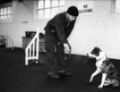
Basic Training
Many rescue dogs can have problems with basic 'manners', simply because they haven't been trained properly in their previous home. This can lead to new owners having to go "back to basics" on training.
- So why train?
- Before you start.
- Sit
- Down
- Recall
- Walking to heel
- Jumping up
- Play biting and mouthing
- Car travel
- Housetraining
- Fears and Phobias
- Mental and Physical Stimulation
So why train?
 Even if your dog doesn't have problems with his manners, training is still an important part of your relationship with him as it creates a bond between dog and owner.
Teaching your dog even the most basic of commands means you can control his actions, and also ensures that he fits in with the social etiquette imposed on him by the human world. Remember that it's the responsibility of all dog owners to ensure that dogs are controlled in public places.
Ideally, all dogs would be trained as puppies as they learn more quickly and, once they've mastered the commands, with practice they retain them for life.
However, if you've taken on a rescue dog this may not be possible. Sometimes you may find yourself faced with a dog which has either never been trained or has forgotten what he was taught in the first place. Do not despair! Training classes are always a great idea, and you should enrol in one as soon as you can after taking your new dog home. There are also lots of commands you can teach your dog yourself at home. Ali Taylor, Head Behaviourist at Battersea Dogs & Cats Home, offers some useful pointers on how to go about training your dog.
Before you start.
Before you start training, there are a few useful things to remember.
- Make training sessions a positive experience for both you and your dog.
- Keep sessions short - three ten-minute sessions are better than one thirty- minute one.
- Always end on a good note - ask your dog to do something he's good at, and reward him well.
- Stop if you feel yourself getting frustrated or angry, as you will pass these feelings on to the dog.
- Use kind facial expressions and body posture, and be clear in your commands. Reinforce each command with hand, arm or body signals.
- Be consistent in your training and praise and use the same commands and praise in each session.
- Reward correct actions immediately.
- Use rewards to your advantage - whether they be treats, toys or praise - and use as many as you can. This will keep your dog guessing and fuel his motivation.
- Make training sessions fun! Dogs are born to play, so if the session is fun he will be more likely to learn and remember.
It may take weeks of patience over many training sessions until he gets it right every time. Try not to expect too much of him too soon - he's not designed to respond to the spoken word, so if you don't think he's quite understood, keep trying.
Dogs learn by association - they learn to associate actions with rewards. Keep distractions to a minimum to begin with, then increase them slowly, and try to repeat training sessions in as many different locations as you can. Your dog should pick up on the fact that anything around him is irrelevant, and that only the command that leads to the correct action gets the reward.
Sit
Getting your dog to sit is one of the most basic commands, and the most useful. You have more control over your dog and you can get him to calm down when meeting people or being checked over.
The basic method for getting your dog to sit on command.
Down
The down command naturally follows 'sit', and is a crucial part of dog training. If you can get your dog to go into the down position you may well be able to stop him getting into trouble, especially if other dogs come along. He will seem subservient and not up for a fight. It is also an important factor in gaining control.
There are three ways to teach the down position and you should stick to one method in order not to confuse your dog.
Method 1 - the conventional route
Method 2 - the reward
Method 3 - one for the puppies
Recall
Ever had an embarrassing experience in your local park, bellowing at your dog to come back to you when he seems to have suddenly acquired 'selective hearing'? Being able to effectively recall your dog at any time is very important. Recall is all about being a responsible dog owner.
Apart from 'selective hearing', there are several reasons why dogs don't come when called:
Step 1
Step 2
Once your dog has learnt to come when you call his name, add the recall command so that he gets used to the sound
Step 3
Once he gets the recall command, try introducing a few distractions by taking him outside. Keep him on a long lead and see if he will still come to you
Step 4
Walking to heel
Teaching your dog to walk alongside you, to heel, is an essential part of his training. There is nothing more frustrating or exhausting as an owner than taking the dog out for his daily walks and being dragged all the way. If your dog is constantly pulling on the lead, you have no control over him, and unwanted behaviours may well develop as a result. Walking to heel, both on and off the lead, is essential for basic control.
There are several ways to teach your dog to walk to heel, but you should choose and stick to one to avoid confusing him.
Step 1
Step 2
Step 3
Step 4
Jumping up
Part of the process of training is teaching your dog not to display unwanted behaviours. Some behavioural traits may have been acceptable - or even encouraged - during puppyhood, but can become undesirable as the puppy grows up. Jumping up is one of these.
Dogs jump up at people as a form of greeting and always seem to be attempting to get as close to the person's mouth as possible. If your reaction to this is either attention or affection, your dog will assume that it's in its interest to carry on jumping up in order to keep being rewarded. However, jumping up is not always desirable and could even be dangerous to a frail person or a small child. To stop this behaviour, follow some simple steps:-
Step 1 - ignore the dog
Step 2 - vary the praise when he doesn't jump up
Step 3 - teach him to sit instead of jump
Play biting and mouthing
To a dog, mouthing is simply another one of his ways of communicating - by taking your hand in his mouth to get your attention, but in a far gentler way than a bite. Puppies interact with their mother and siblings (the pack) by pulling at their ears and tails - not intending to hurt or alarm them, but simply to get attention.
However, as puppies grow up, so do their teeth, and other 'pack members' - and some owners - become intolerant of any biting behaviour. When a puppy goes into a home environment he must be taught which behaviour is acceptable to his new family. To correct mouthing and play biting in an adult dog, follow these steps.
Step 1 - just say "no"
If you think you need a more sophisticated approach, try the next step.
Step 2 - the reward for getting 'off'
Keep up the training regularly, and once he's got the knack of the "off" command you can use it to stop your dog from mouthing or play biting. Remember to give praise where it's earned!
Car travel
Are you being driven up the wall by a canine passenger - mad behaviour in the car, car sickness - or both? There are a number of things you can do to help your dog overcome these habits when out in the car.
Barking mad or road-rage?
Two common problems include barking during car journeys and frantic "chasing" activity - in other words, a dog who just can't keep quiet - or still - in the car.
1. Walkies
If you think about it, the majority of trips your dog takes in the car with you usually end up in "walkies", which is very exciting for the dog. Unfortunately for you or your passenger, dogs often express their delight by barking in your ear! Try breaking this behaviour pattern:
2. Car madness
Dogs that bark at anything they see out of the windows can be very wearing, especially on long journeys. Your dog could be doing this for one of two reasons: either he is possessive and attempting to "guard" your car, or he could be showing signs of hunting or herding behaviour - trying to "round up" passing vehicles. Use a lead attached to your dog's collar, so he is able to lie down comfortably below window level in the back of the car (in a hatchback or estate). If he can't see the back of your head when you are driving he is less likely to bark to attract your attention. This is also a good idea from a safety point of view, in the event of a car crash.
a note on puppies
Stopping this type of behaviour in puppies is relatively easy - just make sure he travels in the back of the car from the moment you take him home. Small, cute, vulnerable puppies are often allowed to travel on a passenger's lap, where he gets lots of attention. When he gets bigger and is expected to travel in the back of the car, it's not surprising that he starts to bark or misbehave - he's just trying to get the attention he's come to expect in the car.
Sick as a dog?
Many dogs suffer from car sickness when travelling. In puppies, it's probably a reaction to being taken away from their mother or litter and being placed in a strange moving environment, and it could lead to traumatic associations with cars in later life. There are ways to reduce some of this anxiety and encourage happy and nausea-free travel. Of course, if problems continue, you should see your vet.
Housetraining
Teaching your dog where and when to go to the toilet
When housetraining your dog, it doesn't matter whether you are starting the process with a puppy or an adult dog, your aim is to teach him that it is not acceptable to go to the toilet in the house. Any new dog requires some training, but as we all know, rescue dogs are special, they can also present more of a challenge, as less is known of their history and they may have unknown triggers which cause them to mess at home.
Five easy steps to stress-free housetraining
Housetraining Advice for Your Rescue Dog
During the early days with your rescue dog, try to stick to a schedule for feeding, walking and sleeping. This will help him adjust more quickly to your routines and away from those he was used to in a kennel environment. Until he has had time to adjust, leave newspaper on the floor by the back door whenever you leave him so that he can go to the toilet on this if necessary. Place polythene underneath the newspaper to prevent any leakage onto the floor. This is important as your dog's strong sense of smell will invariably attract him back to go to the toilet in the same place.
Most adult dogs will have been house-trained, but some may have been in kennels for a long time and may need reminding. Take your dog outside to the garden on numerous occasions and build up the routine of regular walks during the first few days to remind him of the right place to go. When taking him to the garden, make sure you stay with him for reassurance, and praise him when he goes to the toilet. Older dogs normally prefer a secluded area in the garden to relieve themselves, and may be unwilling to go to the toilet while on a lead.
Your dog is likely to be both excited and slightly anxious during the first few days of his new life. He may develop loose bowels, which may in turn cause him to have house-training accidents. If this occurs, try not to be upset or react adversely towards him. Clean the soiled area with biological washing powder solution or special products available from your veterinary practice. Many other household cleaning products will not remove the smell entirely, and your dog may be attracted back to the area.
Fears and Phobias
Dogs can harbour anxieties and phobias just like we do, though often to an even greater extent. Common phobias often include vacuum cleaners, thunder or any loud, sudden noises, but some rescue dogs in particular can have even more irrational-seeming fears such as brooms.
If you have had your dog since puppyhood, you may be able to work out the triggers which make him behave this way. However, rescue dogs can often present more of a challenge, as less is known of their history.
Puppy to Adult
As a puppy is growing up he will naturally come across a wide range of new and potentially frightening, even terrifying, situations. But with the reassuring presence of his mother, brother, sisters, and eventually his owner, the young dog can get used to dealing with them. Any dog's future depends on his early experiences and training, as does his capacity to assess situations more or less likely to cause fear or distress.
Another factor is where and how the puppy has been raised. If reared in a quiet, remote area where he is unaccustomed to everyday noises, then he will of course become immediately suspicious or fearful if rehomed to a noisy environment. Many rescue dogs experience this, and Battersea receives some who have never been socialised with other dogs, let off a lead, or taken out much, so fear of traffic noises is a common phobia.
Equally, if adult dogs develop a fear then this could rub off onto a litter. It is important to introduce any puppy to as many different noises and places as possible whilst he is young enough to decrease the chance of such phobias arising later in life.
Even if an adult dog finds certain situations terrifying, it is never too late to take remedial action. There are a number of ways of lowering the dog's level of sensitivity to anxiety-causing stimuli. Thunderstorms often cause panic for several reasons. Firstly, changes take place in atmospheric pressure and humidity, which dogs are far more sensitive to than humans. Then there are changes in light conditions; in particular a darkening sky and flashes of lightening. Finally, there is usually heavy rainfall punctuated by loud claps of thunder. Although it is clearly not possible for the owner to familiarise the dog with all these eventualities, much can be done to overcome any fear of loud noises.
Desensitisation
The method is quite simple: play your dog a recording of thunder; initially so low that he does not react, then gradually increase the volume after a few days, but don't rush this part or you could end up undoing all your good work.
At the same time, reassure him, play with him and reward him with his favourite treats and toys. A dog will not eat if he is afraid. Therefore, if he accepts a piece of treat during this training session then you are well on your way to winning him over. You will then be able to use this system to block out any noises from outside; the trick is to distract your dog with pleasant alternatives to the noise causing the phobia. This will involve some work on your part as you will need to provide these distractions whenever there is a thunderstorm, for instance, but in time you should succeed in totally desensitising your dog to the problem.
There are a number of soundtracks available with a range of noises - from children crying, fireworks, gunshots etc. - that you can use to help with the process. These are available from any major music retailers. Alternatively, you could record some soundtracks of your own to play back to your dog.
Four Easy Steps to Dealing With Phobias
Mental and Physical Stimulation
Going Mental
During the alarming outbreak of foot and mouth disease in 2001, many owners found it difficult to give their dogs their usual amount of exercise. But, interaction with your dog is always important, whether or not you are restricted in where you can walk him. Depending on his individual needs, you need to make sure you are keeping your dog both physically fit and mentally alert. For example, if you own a Border Collie, a daily walk is not enough. Collies are highly intelligent and will need plenty of additional stimuli at home regardless of whether or not you are with them all day.
Game On - physical stimulation
Interactive games involving both you and your dog working together are an excellent and enjoyable way of training your dog in simple tasks. They can also provide him with some of the mental stimulation he may be lacking. Here are some guidelines for a simple retrieval exercise which you can try at home in the garden:
You could also try other games - such as tug of war or hide and seek - in the garden.
Give a Dog a Bone - using food for training and stimulation
Food is an important part of your dog's daily routine and if used inventively can keep him amused for ages.
Whether you are temporarily restricted in the areas where you can walk your dog or not, it's a good idea to continue these games and activities as a way of spending time with him and showing him that you are happy to give him lots of attention.
 Send to a friend