|

|
|
Everyone
has heard of the
extraordinary loyalty that dogs are
capable of. At Battersea every dog and cat
has a story to tell, some of these stories
we know, some we will never know, but
certainly all animals in our care are
heroes in their own right. Some dogs go on
from Battersea to provide further service
to the community, even after all they have
been through. Here is just a small
selection of our Home Heroes:
Hearing Dogs for
Deaf People
In late 1994 Battersea struck up a liaison
with the charity Hearing Dogs for Deaf
People. This charity selects dogs and then
trains them to be the ears for severely
deaf people. The dogs alert deaf people to
every day sounds that hearing people may
take for granted, such as alarm clocks,
doorbells, telephones, smoke alarms, baby
alarms and cooker timers to name just a
few.
They select dogs with high intelligence
and friendly disposition showing keen
responses to sound and a willingness to
please.
|
|
|
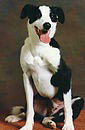
Batsy was the first
Battersea dog to be selected for training
in early 1995. Unfortunately he didn't
quite make the full grade, but was good
enough to become a Companion Dog
|
|
|
|
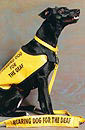
Dilly was the first
Battersea dog to 'pass out' of Hearing
Dogs training on 01 May 1996 after one
years training.
|
|
|
|
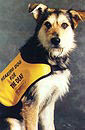
Kenya was selected
from Battersea in November 1996 when she
was 5 months old. After 5 months of puppy
socialising she started her full training
and the following September she was
awarded her 'jacket' and went to live in
Cambridgeshire with a deaf lady and her
son. She now stars on the front of the
Hearing Dogs brochure.
|
|
|
|
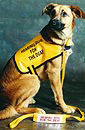
Paddy is the most
recent Battersea dog to complete training.
He was selected in December 1996 and
passed out in March 1998. It is so
encouraging that any type of dog, no
matter what size, breed, shape or colour,
can have the qualities needed to be
trained as a Hearing Dog.
|
|
|
Defence
Animal Centre
For hundreds of years, dogs have been used
to provide assistance in all fields of
work take the St. Bernards for mountain
rescue operations or guide dogs for the
blind as an example. The Dogs Home
Battersea also provides dogs to the
Defence Animal Centre. These dogs can be
trained as sniffer, search and tracker
dogs for drugs and explosives as well as
patrol work.
Assistance dogs go back a long time,
Airedale Jack was just one of these dogs
and his story is told in The History of
Battersea Dogs Home by Lady
Cottesloe:
 In the British War
Museum is a small wooden stand . . . to
the memory of Airedale Jack, a hero of the
Great War. In the British War
Museum is a small wooden stand . . . to
the memory of Airedale Jack, a hero of the
Great War.
Just a dog . . . but a hero who in 1918
saved a whole British battalion from being
annihilated by the enemy. Airedale Jack
was sent over to France as a messenger and
guard. There was a big push on, and he was
taken by the Sherwood Foresters to an
advance post. The battle raged, and things
went badly against the Foresters. The
enemy sent across a terrific barrage,
cutting off every line of communication
with headquarters, four miles behind the
lines. It was certain that the entire
battalion would be wiped out unless
reinforcements could be secured from
headquarters, but how? It was impossible
for any man to creep through the walls of
death that surrounded them. But there was
just one chance - Airedale Jack.
Lieutenant Hunter slipped the vital
message into the leather pouch attached to
the dog's collar. A pat on the head and
then simply: 'Good-bye Jack . . . Go back,
boy'. The battalion watched Jack slip
quietly away, keeping close to the ground
and taking advantage of whatever cover
there was, as he had been trained to do.
The bombardment continued, and the shells
fell all around him. A piece of shrapnel
smashed the dog's lower jaw . . . but he
carried on. Another missile tore open his
tough, black and tan coat from shoulder to
haunch - but on he went, slipping from
shell-crater to trench. With his forepaw
shattered, Jack had to drag his wounded
body along the ground for the last three
kilometres. There was the glaze of death
in his eyes when he reached headquarters -
but he had done a hero's work and saved
the battalion.
Jack, a Battersea dog, was presented with
a posthumous VC.
|
|

|
We still provide
dogs to carry out military and police
tasks. Up to 50 dogs a year pass out from
the Defence Animal Centre and from Police
Training, and on completion of their
training a parade is held for them. Dogs
that are selected and pass out include
German Shepherds, Springer Spaniels,
Rottweillers, Weimaraners, Labradors and
occasionally Pointers, Ridgebacks,
Standard Poodles and Munsterlanders.
|
|
|

|
Raf is one
Weimeraner whose claim to fame was to
'sniff' out £14,000 worth of Cannabis
at Heathrow airport customs. These dogs
are trained to sniff out cocaine,
cannabis, heroin and amphetamines and can
detect one or two grams. Under training,
one of the dogs picked up a scent from a
passenger in one of the Heathrow
terminals. It turned out the person had
been smoking cannabis the night before and
was wearing the same clothes.
|
|
|

|
Mungo Jungo started
his new life in the Army and trained as a
tracker dog. It was decided he would
become a 'Jungle' tracker dog and did much
of his training in Hong Kong.
|
|
|
|